
Conditions
You are here: Home > Conditions > Elbow Pain > Golfer's Elbow
Golfer's elbow is the everyday name for medial epicondylopathy. It causes pain on the inside of your elbow, usually where the tendon attaches to the bone. It can start suddenly or build up over time, often from repeatedly loading the muscles and tendons in your forearm. Although the pain can be severe, golfer's elbow does not usually mean you have seriously damaged your elbow.
Common triggers include:
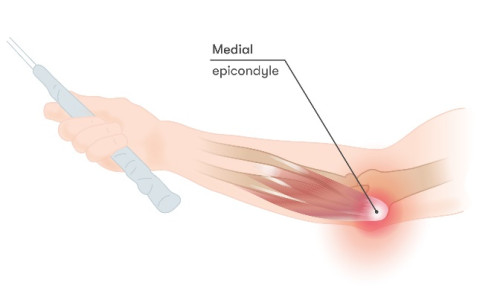
Image credit: https://www.injurymap.com/free-human-anatomy-illustrations
Muscles that move your wrist and fingers connect to the inside of your elbow through a shared tendon. Overusing these muscles, especially during sudden or repetitive tasks, can cause tendon overload. Repetitive gripping activities can cause golfer's elbow.
Anyone can get golfer's elbow. It is most common in adults aged 40 to 60.
Some things can make it more likely, such as:
For many, Reducing activities that make your pain worse. Many people begin to notice improvement within a few months.
If symptoms are severe, keep returning, or relate to heavy work demands, recovery may take longer (12–18 months for some). With the right management, most people improve and return to normal activities.
Scans are not usually needed to diagnose golfer's elbow.
Most people recover with time, although improvement can be slow. There are several things you can do to help reduce pain and improve function.
If symptoms have recently worsened it may be worth reducing or changing activities that make your symptoms worse. Trying to get a balance between rest and activity can help your pain to settle down. Pacing your activities may help. Avoid painful movements like gripping, lifting, or twisting and use ergonomic equipment if available.
Over-the-counter medicines: Over-the-counter pain relief may help you stay active. Always follow the advice provided with the medicine.
Topical creams: Some people find topical creams or gels helpful for short-term relief of pain and stiffness.
It is important to check whether you can take these medicines. If you are unsure whether you can take these medicines, speak to a pharmacist or another healthcare professional.
The muscles involved with Golfer's elbow help you make a fist. Gentle squeezing exercises using a soft ball may be helpful in the early stages, but a progressive strengthening programme usually provides the best long-term results. An adjustable hand strengthener purchased online could help. Slowly building up the strength of the muscles may help your pain.
A splint (also called a brace or strap) can help relieve pain, especially if it's severe. It works by reducing tension on the tendon. Put the brace 2 to 3 finger widths below the inner bony part of your elbow. It should rest just under the painful area. Use the brace during activities that involve your arm. Take it off at night or when you're resting. Try various positions to find what feels best and works well.
If your symptoms aren't improving or you feel you need more help, then please Refer yourself. We will work with you to develop a treatment plan. You can have one-to-one physiotherapy and have access to our gym classes. We can also refer you to other services to access other treatments listed below if appropriate.
In some cases, injections may reduce severe inflammation and pain for a short period. Steroid injections may reduce pain in the short term, but research suggests they may delay recovery over the longer term. They are therefore only suitable for some people.
Considered only if symptoms are severe and don’t improve with other treatments. It is rare for people to need surgery for golfer's elbow.
Golfer’s elbow is influenced by how tendons are loaded, by the body’s ability to recover and our overall health. Smoking, diabetes, poor sleep, and long-term stress are known to negatively affect tendon health and healing. Staying active, gradually strengthening the tendons, and addressing lifestyle factors can help reduce pain and improve function. More support with health and lifestyle factors can be found on our Your Musculoskeletal Health webpage.
When to seek further advice
Some elbow problems need urgent medical assessment rather than physiotherapy. Please read the information below.
This information may not be appropriate for you if you have any of the following:
If you have any of these symptoms, contact NHS 111 as soon as possible for advice.