
Conditions
You are here: Home > Conditions > Wrist & Hand Pain > Trigger Finger
Trigger finger is a condition where one of your fingers gets stuck in a bent position and then suddenly straightens with a snap — like a trigger being pulled and released. It happens when the tendon that bends the finger and the surrounding tendon sheath become thickened. This makes it harder for the tendon to glide smoothly, causing the finger to catch or lock.
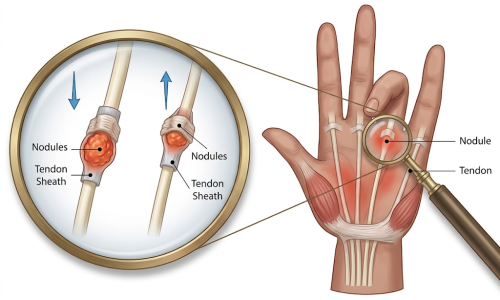
Image credit: https://www.injurymap.com/free-human-anatomy-illustrations
This is a relatively common problem. more common in people over the age of 40 and in people with diabetes or rheumatoid arthritis.
Pain and stiffness at the base of the finger or thumb
A popping or clicking sensation when moving the finger
Tenderness or a small lump (nodule) at the base of the affected finger
Finger locking in a bent position, which may suddenly release. This often happens first thing in the morning
Avoid repetitive gripping, prolonged finger use or forceful grasping that worsen symptoms. Trigger finger often improves with time, although symptoms can take several months to settle.
Over-the-counter medicines: Over-the-counter pain relief may help you stay active. Always follow the advice provided with the medicine.
Topical creams: Some people find topical creams or gels helpful for short-term relief of pain and stiffness.
It is important to check whether you can take these medicines. If you are unsure whether you can take these medicines, speak to a pharmacist or another healthcare professional.
Gently bending and straightening the fingers may help to maintain movement and reduce stiffness. It may also help to reduce the pain. Some people find gentle squeezing exercises helpful once pain begins to settle. Avoid exercises that make the finger repeatedly lock or catch.
Wearing a finger splint, particularly overnight, may help reduce catching and allow the tendon to rest. Splints are usually worn for several weeks. If you are unsure which type of splint is suitable, speak to a healthcare professional.
If your symptoms aren't improving or you feel you need more help, then please refer yourself to physiotherapy. Following assessment, your physiotherapist will discuss the most appropriate treatment options, which may include advice, exercises, splinting, injection or referral for further treatment if needed.
A corticosteroid injection can reduce pain and improve finger movement. It is often an effective treatment for trigger finger, particularly when symptoms have not improved with self-management or splinting. It is not suitable for everyone.
If symptoms do not improve with other treatments, surgery may be considered. This is usually a small day-case operation to release the tight part of the tendon sheath.
Symptoms and recovery can be influenced by overall health. Diabetes, as well as carrying excess body weight and smoking may further impact tissue health and symptom resolution. Addressing these factors through lifestyle changes and early support can reduce symptom impact and improve hand function. More support with health and lifestyle factors can be found on our Your Musculoskeletal Health webpage.
When to seek further advice
Some wrist and hand problems need urgent medical assessment rather than physiotherapy. Please read the information below.
This information may not be appropriate for you if you have any of the following:
If you have any of these symptoms, contact NHS 111 as soon as possible for advice.