
Conditions
You are here: Home > Conditions > Neck Pain > Neck and Arm Pain (Cervical Radiculopathy)
Neck pain that spreads into the arm may be caused by an irritated nerve in the neck. Cervical radiculopathy is the technical term for pain caused by irritation of one of the nerves in the neck. It can cause pain that starts in the neck and travels into the shoulder, arm or hand. Some people also experience pins and needles, numbness or, less commonly, weakness in the arm.
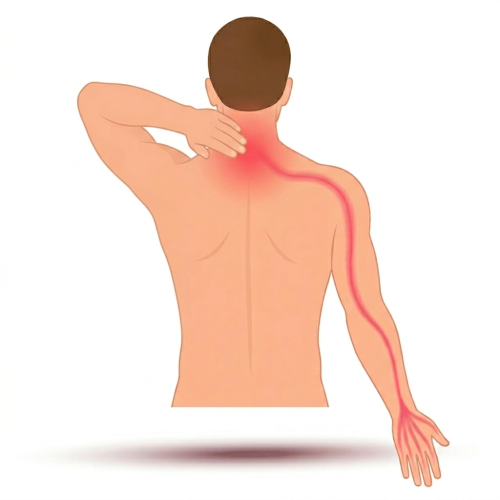
Image credit: https://www.injurymap.com/free-human-anatomy-illustrations
Cervical radiculopathy happens when one of the nerves in your neck becomes irritated or compressed. It can happen when a nerve in the neck becomes irritated or compressed. Common causes include age-related changes in the spine or a bulging disc. Most people recover within 6-12 weeks. Some people develop symptoms after an injury, while others have no obvious cause.
The main symptoms of cervical radiculopathy are:
Although the pain can be severe, most people recover well without surgery. Nerves often take longer to settle than muscles or joints, so symptoms may improve gradually over several weeks or months.
Try to keep moving, even if you need to reduce your activities at first. Find a balance between movement and rest, avoid staying in one position for long periods, and gradually increase your activity as your symptoms improve.
Some find it difficult to find a comfortable sleeping position initially. There is no right or wrong position to sleep in. There is no single "best" pillow. Use whichever pillow allows you to sleep most comfortably.
Over-the-counter medicines: Over-the-counter pain relief may help you stay active. Always follow the advice provided with the medicine.
Topical creams: Some people find topical creams or gels helpful for short-term relief of pain and stiffness.
It is important to check whether you can take these medicines. If you are unsure whether you can take these medicines, speak to a pharmacist or another healthcare professional.
A hot water bottle or wheat pack applied to the neck may help the pain. Applying this for 10-15 minutes may provide short-term relief. Wrap heat packs in a towel and do not place them directly onto your skin to avoid burns.
Consider light aerobic exercise at first such as walking, swimming, or cycling. Gentle mobility exercises and graded strength exercises may also help. See the Arthritis UK neck exercises which may help.
If your symptoms aren't improving or you feel you need more help, then please refer yourself to physiotherapy. We will assess your symptoms and work with you to develop a treatment plan. You can have one-to-one physiotherapy and have access to our gym classes. We can also refer you to other services to access other treatments listed below if appropriate.
These are occasionally completed for severe flare-ups that aren’t settling. Physiotherapy and pain relief are recommended before considering an injection. Injections may reduce persistent pain for a period. The physiotherapy service can refer people to the pain team for possible injections. It is not an appropriate option for everyone.
Surgery is only recommended for a small number of people. This is not an appropriate option for everyone. Your physiotherapist would discuss your referral options with you if required.
The symptoms described in the "When to seek further advice" box can be a sign of a condition called cervical myelopathy. Although uncommon, it needs urgent medical assessment because early treatment is important. If untreated it can lead to permanent leg, arm, bladder, bowel and/or sexual dysfunction. You can find more information about degenerative cervical myelopathy on NHS inform.
There are many causes of neck pain. Although the symptoms can be distressing, most do improve with time. There are circumstances where a medical opinion is appropriate. If you are experiencing any of the following, please contact 111 or your GP for advice.
Neck pain with severe dizziness, fainting, double vision, difficulty speaking or difficulty swallowing.
A severe new headache with neck pain, especially if you also have a fever or feel very unwell.
Severe pain that is getting worse, especially at night and not relieved by changing position.
Neck pain and new arm or leg weakness or lack of co-ordination
Pain that started after a serious accident, such as after a car accident
Neck pain and a history of previous cancer
Neck pain with a diagnosis of osteoporosis
Many people ask whether they need a scan. It is natural to think an MRI scan would be helpful to guide management and provide a diagnosis. In most circumstances it does not change treatment. An MRI scan shows detailed images of the neck, however a scan is not usually needed to diagnose cervical radiculopathy.
There are circumstances where further investigations are necessary. For example, suspected cervical myelopathy, significant new muscle weakness, a serious underlying condition, or persistent cervical radiculopathy symptoms. A healthcare professional would recommend further investigation in these contexts.
The information below is reproduced from NHS England's BestMSK patient advice to help explain what an MRI scan can and cannot tell us, and when an MRI may be appropriate.
Some important things you need to know about what an MRI scan can tell us and when it is appropriate
MRIs provide a picture of the anatomy of the spine.
MRIs cannot tell how someone feels and are not a diagnosis.
MRIs can be used to plan treatment with you and rule out serious conditions such as cancer or fractures.
MRIs are rarely needed for people with back or neck pain.
MRIs should be requested after assessment by a specialist.
Some important things you need to know about your MRI scan report
Some of the medical words used in MRI reports can be complex and may sound scary.
For example, eight out of ten people aged 50 or over with NO pain have something called ‘degeneration of discs’ noted in their MRI report. However, findings such as this are more common as we become older and can be signs of a naturally maturing spine.
If you have any questions about having an MRI scan or need clarification on the report of an MRI scan, please discuss these with the clinician who sent you for the MRI.
Symptoms associated with cervical radiculopathy can be influenced by our overall health. Physical activity levels, carrying extra weight, long-term stress and sleep quality can impact on overall health. Smoking and alcohol consumption may also negatively impact bone health and affect the spine over time. Addressing lifestyle factors and maintaining general health can support recovery. More support with health and lifestyle factors can be found on our Your Musculoskeletal Health webpage.
When to seek further advice
Most neck pain, arm pain, numbness or weakness is not caused by a serious problem. However, new or worsening symptoms affecting your nerves or spinal cord require urgent medical assessment.
Please contact your GP urgently if you develop any of the following:
Changes to your hands or arms
Changes to your walking or balance
Changes to bladder or bowel function
Other concerning changes
These symptoms can sometimes be a sign of degenerative cervical myelopathy (DCM), where the spinal cord in the neck becomes compressed. Although uncommon, early assessment is important as treatment can help prevent further deterioration.