
Conditions
You are here: Home > Conditions > Wrist & Hand Pain > De Quervain's Tenosynovitis
De Quervain’s tenosynovitis is a painful condition affecting the tendons on the thumb side of your wrist. It occurs when the two tendons that help move your thumb (abductor pollicis longus and extensor pollicis brevis) become overloaded.
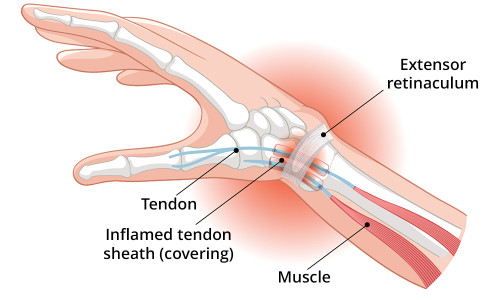
Image credit: https://www.injurymap.com/free-human-anatomy-illustrations
The condition is common, especially among new parents or people who do repetitive activities. For most people, this develops after a sudden increase in hand and wrist activities. The good news is it usually responds well to conservative treatment. Most people improve over several weeks to a few months, although recovery can take longer if symptoms have been present for some time.
If symptoms have recently worsened it may be worth reducing or changing activities that make your symptoms worse. Trying to get a balance between rest and activity can help your pain to settle down. Pacing your activities may help. Reducing repetitive gripping, lifting and twisting may help while the pain settles. You may find it helpful to avoid lifting with the thumbs pointing towards the ceiling as this can irritate the tendons.
Over-the-counter medicines: Over-the-counter pain relief may help you stay active. Always follow the advice provided with the medicine.
Topical creams: Some people find topical creams or gels helpful for short-term relief of pain and stiffness.
It is important to check whether you can take these medicines. If you are unsure whether you can take these medicines, speak to a pharmacist or another healthcare professional.
Exercises can help improve movement and gradually strengthen the thumb and wrist. Arthritis UK wrist and hand exercises may help your symptoms.
A thumb splint can help reduce pain by resting the irritated tendons. Wearing the splint during activities that make your symptoms worse, or for short periods during the day, may help while the condition settles. Thumb splints are available from most pharmacies and online retailers. If you are unsure which splint is suitable, speak to a healthcare professional.
If your symptoms aren't improving or you feel you need more help, then please refer yourself to physiotherapy. We will assess you and work with you to develop a treatment plan. You can have one-to-one physiotherapy. We can also refer you to other services to access other treatments listed below if appropriate.
If symptoms do not improve with self-management and splinting, a corticosteroid injection can be an effective treatment for many people. It is not an appropriate option for everyone. If you are breastfeeding, this treatment may not be suitable. Your physiotherapist will discuss this with you.
Considered only if symptoms are severe or do not improve with other treatments. It is rare for people to need surgery for this condition.
De Quervain’s symptoms are affected by how the wrist and thumb are used over time and by overall health. Conditions such as diabetes, carrying excess body weight, long-term stress, disrupted sleep and smoking, may slow recovery and increase symptom persistence. Staying active, gradually strengthening the tendons, and addressing lifestyle factors can help reduce pain and improve function. More support with health and lifestyle factors can be found on our Your Musculoskeletal Health webpage.
When to seek further advice
Some wrist and hand problems need urgent medical assessment rather than physiotherapy. Please read the information below.
This information may not be appropriate for you if you have any of the following:
If you have any of these symptoms, contact NHS 111 as soon as possible for advice.